Fluoride is a critical parameter that must be monitored in wastewater treatment plants for three core reasons:
1. Significant Impact on Human Health from Excessive Fluoride Intake
Long-term consumption of water with fluoride levels exceeding 1 mg/L can lead to dental fluorosis (tooth discoloration and defects). When concentrations exceed 4 mg/L, the incidence of dental fluorosis reaches 100%, and skeletal fluorosis may occur, causing patients to suffer from bone pain, deformities, and an increased risk of fractures. Excessive fluoride can also affect the nervous system, kidney function, and thyroid hormone secretion. Once fluoride enters water bodies, it readily accumulates in soil and groundwater, bio-magnifying through the food chain and posing a risk of regional toxicity.
2. Ecological Damage Caused by Excessive Fluoride
High concentrations of fluoride inhibit the growth and reproduction of aquatic organisms, disrupting the ecological balance of water bodies and even leading to poisoning and death. When fluoride-containing wastewater enters the soil, it affects soil microbial activity and mineral composition, resulting in stunted plant growth and necrotic spots on leaves. Moreover, environmental remediation of excessive fluoride is challenging. Fluoride migrates strongly in groundwater, is not easily degraded, and can persistently contaminate underground water sources, jeopardizing regional water resource security.
3. Disruption of Wastewater Treatment System Stability
High fluoride concentrations (>20 mg/L) increase the osmotic pressure of wastewater, causing microbial cells to lose water and reduce their activity, thereby affecting the biochemical treatment efficiency of the plant. In acidic environments (pH < 6), F⁻ ions readily form more toxic HF molecules, further inhibiting microbial activity. Finally, fluoride can react with calcium and magnesium ions in the wastewater to form precipitates, leading to scaling and blockage of pipes and equipment.
According to Chinese national standards, the fluoride discharge limit for municipal wastewater treatment plants and industrial wastewater treatment facilities is generally below 10 mg/L (in provinces with stricter environmental requirements, such as Jiangsu and Shandong, the limit is below 1.5 mg/L). Surface water and drinking water standards are even more stringent, requiring fluoride levels below 1.0 mg/L. These regulations highlight the stringent control required for fluoride.
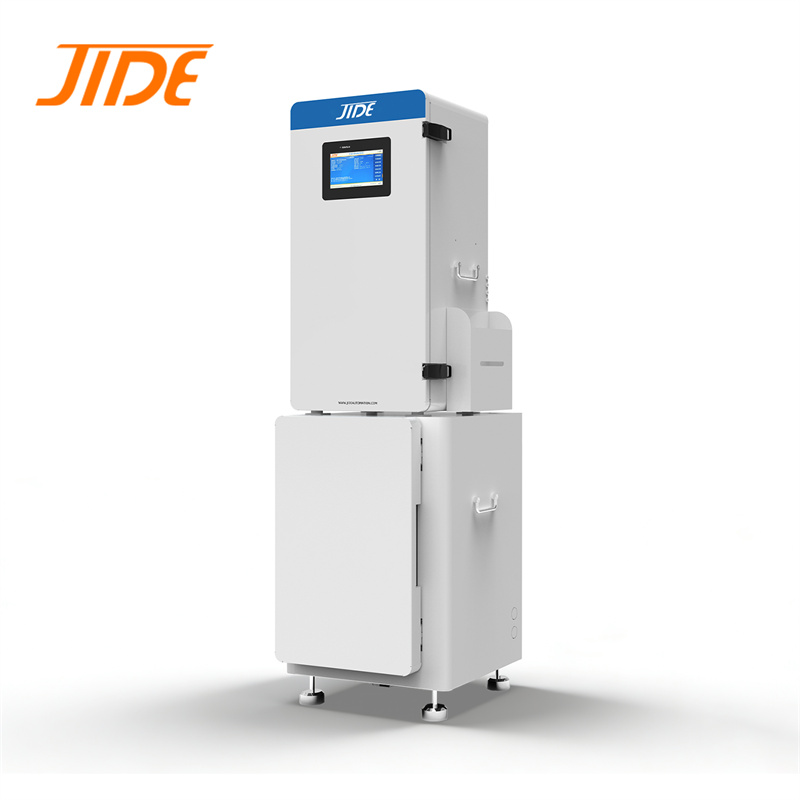
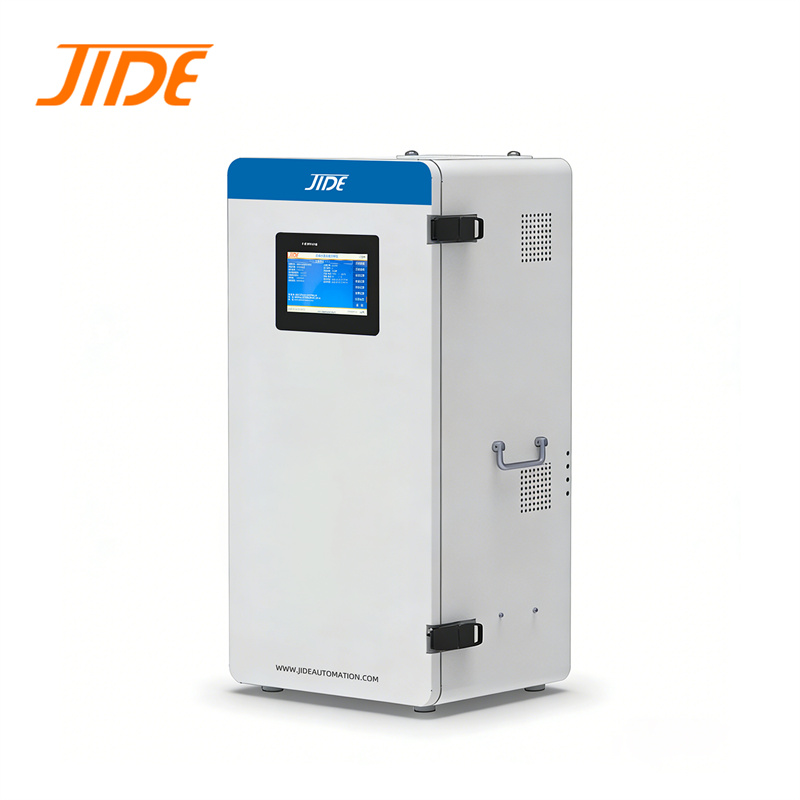
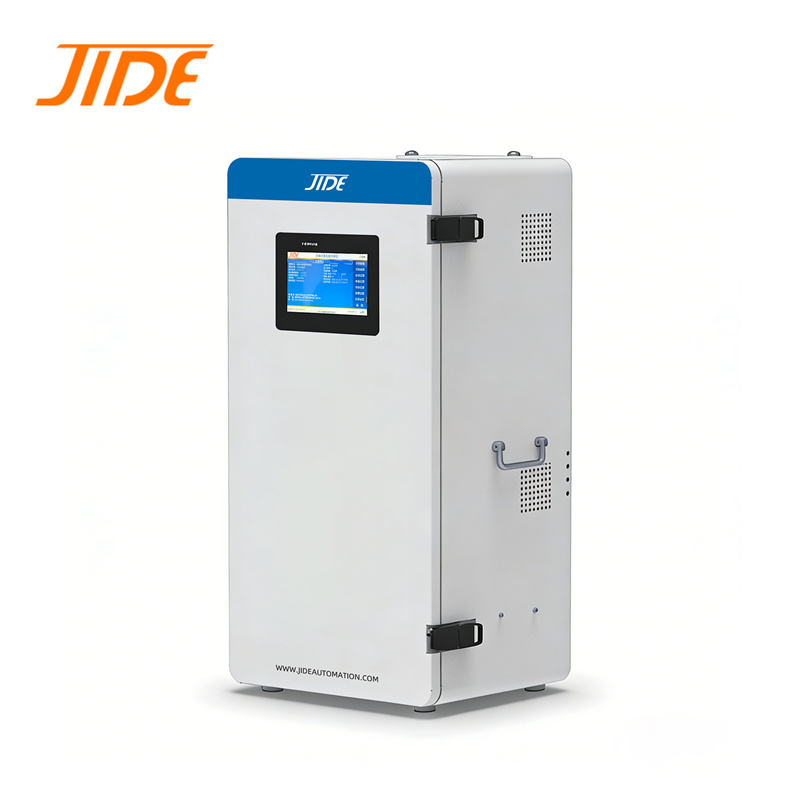
The fluoride online analyzer manufactured by JIDE adopts the national standard method HJ 488-2009 "Water Quality – Determination of Fluoride – Fluorine Reagent Spectrophotometry." The principle is as follows: In a specific buffer medium, fluoride ions react with fluorine reagent and lanthanum nitrate to form a blue ternary complex. The absorbance is measured via spectrophotometry, and the fluoride concentration in the water sample is calculated. The measurement cycle and range are configurable. The instrument supports MODBUS RS485 output, and repeatability, accuracy, and drift are all controlled within 10%, making it a reliable solution for fluoride online monitoring.
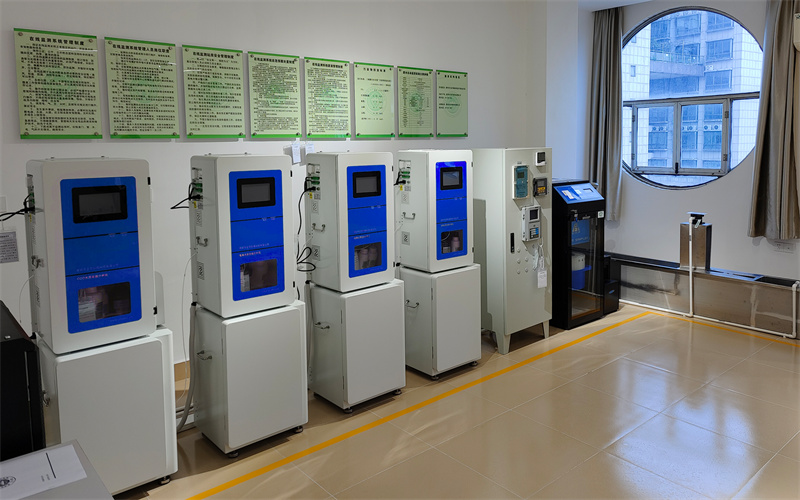
Typical Use Case
Key Industrial Wastewater Treatment Plant, Eastern China
In early 2025, this plant installed multiple JIDE online analyzers. The customer reported that the JIDE fluoride online monitoring device showed data significantly higher than their in-house laboratory results. They strongly questioned the device's accuracy, fearing it would affect their environmental compliance and discharge permits, and demanded that JIDE immediately investigate and identify the root cause of the data discrepancy.
JIDE Response:
Upon receiving the request, JIDE technical support first conducted a remote diagnostic check. They thoroughly verified the equipment calibration parameters, operational status, and sampling line conditions, confirming that the device was calibrated correctly with no hardware failures or drift issues.
Subsequently, JIDE re-tested retained on-site water samples. The original water sample measured 6.3 mg/L on the device; after a 1:1 dilution, the re-test result was 3.2 mg/L. The linear correlation between the two sets of data was good, preliminarily verifying that the device's monitoring was accurate and that the discrepancy was not due to equipment malfunction.
The customer did not accept the dilution verification results and insisted that the JIDE device was inaccurate. They independently performed a comparative test using a third-party electrode method. The electrode method yielded a result of 6.1 mg/L for the original water sample, which was essentially consistent with the JIDE device's data. However, the customer's in-house laboratory, using a colorimetric method, obtained a result of only about 2 mg/L. When they diluted the sample by half and re-tested, the result remained around 2.2 mg/L, failing to decrease proportionally with dilution—clearly indicating an anomalous and invalid laboratory result.
JIDE application engineers then consulted the relevant national standard and clarified that the upper measurement limit of that specific colorimetric method is only 1.8 mg/L. The customer's actual raw water concentration exceeded the effective range of the method, rendering the laboratory data completely unreliable.
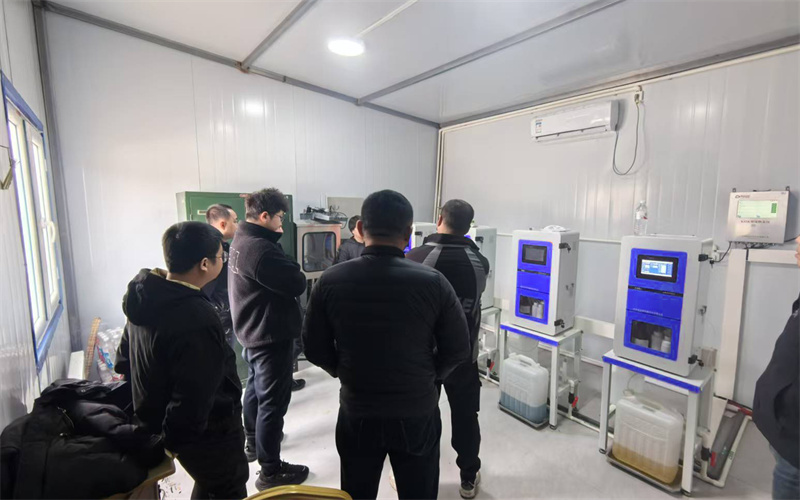
To completely resolve the customer's doubts, JIDE guided them through a gradient dilution verification:
2x dilution: measured 2.2 mg/L
4x dilution: measured 1.7 mg/L
8x dilution: measured 0.795 mg/L
When back-calculated, the 4x and 8x dilution results corresponded to original concentrations of 6.8 mg/L and 6.36 mg/L, respectively. These values were highly consistent with the JIDE online analyzer's reading of 6.3 mg/L and the third-party electrode method's reading of 6.1 mg/L, fully validating the accuracy of the JIDE device's monitoring data.
Conclusion
The final determination was that the JIDE device was not faulty. Instead, process fluctuations at the upstream front end of the customer's wastewater treatment facility had caused the actual fluoride concentration in the water sample to exceed the limit.
Throughout this service engagement, the JIDE device demonstrated stable and reliable monitoring performance, and our after-sales team responded with professional and efficient support. We precisely identified the root cause of the issue, completely resolved the customer's concerns, and ensured their environmental monitoring operations remained stable and compliant. The customer highly commended the quality of JIDE's products and the caliber of our service.

 EN
EN